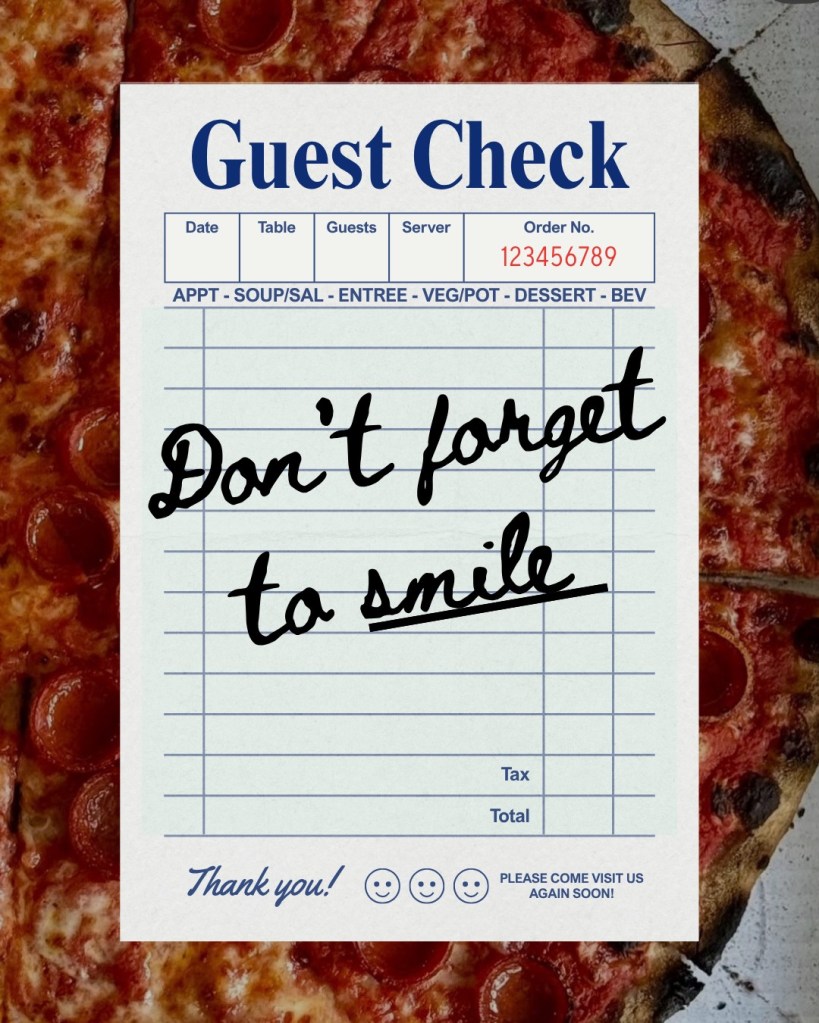
“Don’t forget to smile.” That’s what I would write at the top of every guest check when I returned to my part-time waitressing job after my mom died. It was a subtle reminder to perform. And when I opened my book to greet a table, those words were the first thing I’d see.
Grief is strange. It consumes you, yet the world expects you to show up composed, and ready to move on. I learned to wear a mask. For weeks after my mom died, I practiced smiling in the mirror. I’d study how forced it looked. Smiling felt so foreign to me now.
None of those smiles were real, but in a world that prefers comfort over truth, pretending became its own kind of survival.
But something has shifted in me recently.
I’ve started answering honestly when people ask how I am. I’m done buffering my responses to make others comfortable. I’m done softening my truth so it fits neatly into small talk.
I remember one of my first days back to waitressing after being gone for weeks. Some of my regulars came in and asked where I’d been.
I paused. I had a split second to decide what I’d say.
“My mom died,” I said, “so I’ve been dealing with that.”
It wasn’t dramatic. It wasn’t heavy. It was just the truth. And it felt good to say it out loud, to not hide behind a smile or a convenient lie.
I’ve stopped trying to make my grief palatable to others. I don’t owe anyone a polished version of my pain.
Grief doesn’t need to be edited down to make others feel at ease. It just needs space to breath to be spoken about, without apology.
So now, when someone asks how I am, I tell them the truth.
Sometimes I’m okay. Sometimes I’m not.
This is me grieving.
 This is me Grieving